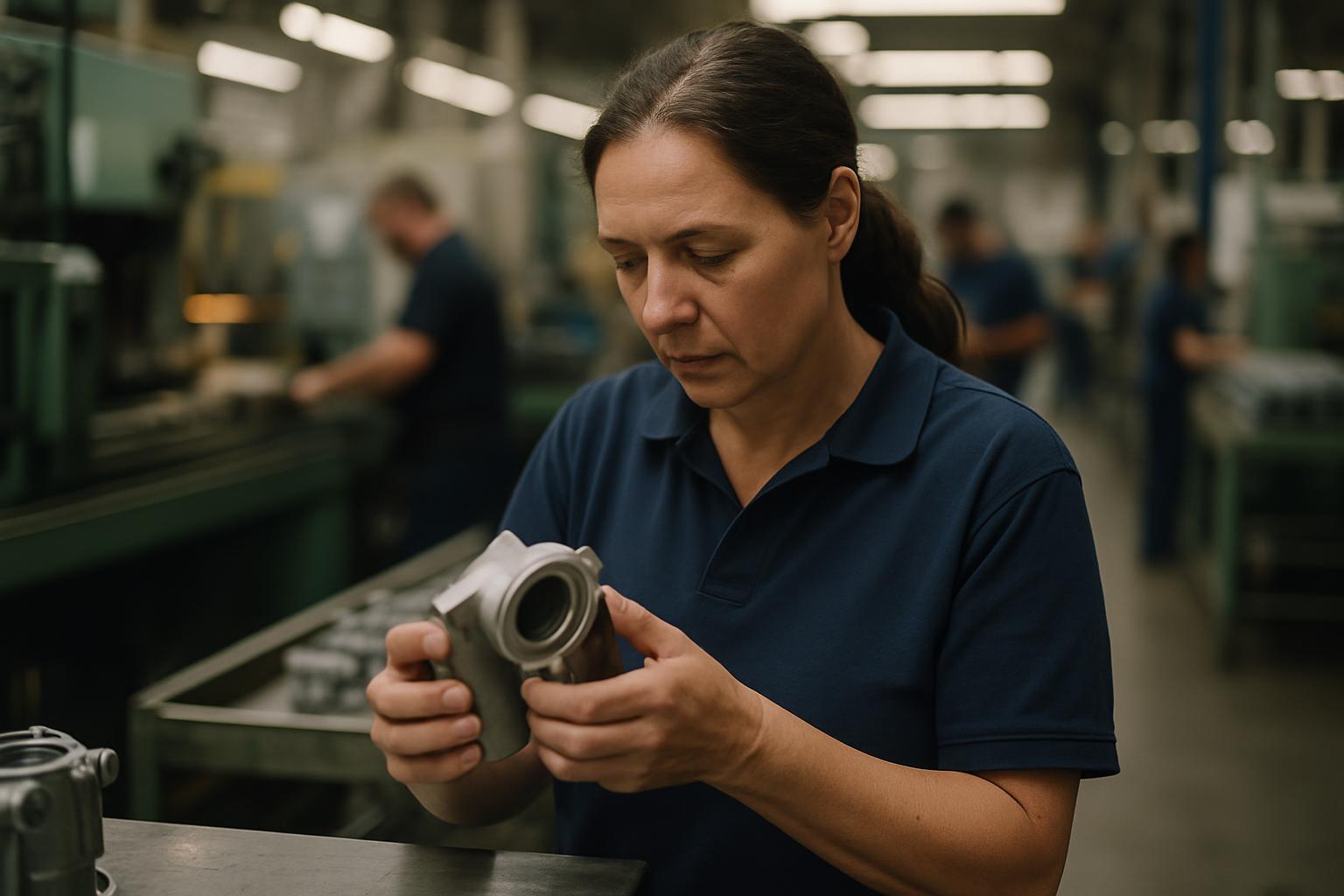
Why defects need to be caught at the source
The cost of a defect rises every minute it goes undetected. A scratch caught at the workstation is a quick rework. The same scratch caught at final inspection means a finished unit gets pulled, disassembled, and reworked — or scrapped. Caught by the customer, it becomes a return, a credit note, and a dent in your reputation that no rework fixes. This is the classic rule of escalating cost: catching a problem at the source is cheaper than catching it one stage downstream, which is cheaper again than catching it after shipment.
Source detection also preserves information that's lost the moment a part moves on. The operator who made or handled the part knows what tool they were using, what the material looked like, whether the machine sounded off. An hour later, on a different job, that context is gone. A defect logged at the station — with a photo of the exact part and a note while the memory is fresh — captures cause and effect that a downstream inspector can only guess at.
None of this happens unless reporting is frictionless. Quality systems fail not because people don't care about quality, but because the act of reporting is slow, interruptive, or feels like paperwork that disappears into a void. The goal is a system where logging a defect takes seconds, requires no login at a shared station, and visibly leads to something — so the operator sees the point in doing it again.
What a good defect record actually contains
A useful defect entry answers four questions without anyone having to follow up: what is wrong, where it happened, what it looks like, and how bad it is. "Surface defect" is useless. "Burr on the leading edge of bracket P-220, left side, station 4, first off after tool change" is something an engineer can act on. The discipline is to describe one defect, specifically, in language the next person can use without a phone call.
A photo is the single most valuable field. It removes argument about severity, shows the exact location and extent of the defect, and lets a quality engineer triage without walking to the floor. A timestamped, geotagged image — tied to the station or line where it was captured — also anchors the record in time and place, which matters enormously when you're investigating a batch or responding to a customer claim weeks later. Words describe; photos prove.
Then add structure that lets you analyze later: a category or defect code (scratch, dimensional, contamination, missing component), the part or product number, the line or cell, and a severity. Severity is what drives the response — a cosmetic blemish and a safety-critical dimensional failure can't share a queue. Capturing these as consistent fields, not free text, is what turns a pile of individual reports into data you can chart, sort, and act on.
Categorizing defects so the data is usable
A flat list of defects tells you how many. A categorized list tells you why. The point of a defect code is to let you group hundreds of individual reports into a handful of patterns — so you can see that 60 percent of this month's rejects are one type of surface flaw on one product, rather than a vague sense that "quality is down." That is the difference between firefighting and root-cause work.
Keep the category list short and unambiguous. If operators have to choose between fifteen near-identical options, they'll pick inconsistently and the data turns to noise. A practical scheme uses a small set of top-level types — dimensional, surface, contamination, assembly, material, documentation — with the specifics living in the photo and the note. You can always refine codes later from real data; you can't recover detail operators never captured because the form was too complicated.
Once defects are categorized, simple analysis pays off fast. A Pareto view — sorting defect types by frequency or by cost — almost always shows that a few causes drive most of the loss. That is where you aim your corrective action. Defect quality tracking earns its keep here: not in the logging itself, but in the patterns the logs reveal once you can slice them by type, line, shift, part, and time.
Routing defects to the people who can fix them
Catching a defect is only half the job — the other half is making sure the right person hears about it without delay. A dimensional failure might need a process engineer and a halt on that machine. A contamination issue might need the line lead and the supplier-quality contact. A documentation error might just need the shift supervisor. If every defect lands in one shared inbox, the urgent ones drown and the routine ones get treated as urgent.
Per-category routing solves this: define once who owns each defect type, and let every new report go straight to that owner. The operator doesn't have to know the org chart — they pick the category, and the system delivers it. This is also where severity earns its place. A safety-critical defect can trigger an immediate notification and a containment step, while a cosmetic one queues for the daily review. Routing rules turn a reporting system into a response system.
Closing the loop matters as much as opening it. A defect that's been raised but never confirmed fixed is just an open risk with a timestamp. Follow-up reminders keep items from stalling, and a clear owner per item means accountability doesn't evaporate at shift change. The measure of a defect-tracking process isn't how many defects you log — it's how many you close, with evidence, and how fast.
Building an audit-ready quality record
If you supply regulated industries — automotive, aerospace, medical, food — or hold a certification like ISO 9001, your defect records aren't just internal hygiene. An auditor or a customer can ask to see how a specific defect was found, who was notified, what was done, and when it was confirmed resolved. A trail that exists only in memory, group chats, and a spreadsheet someone overwrites is a finding waiting to happen.
An audit-ready record is immutable and time-stamped end to end: when the defect was raised, by whom, the photo as captured, who it was routed to, every status change, and the confirmation of the fix. Crucially, the original report shouldn't be quietly editable after the fact — corrections should be additions to the record, not replacements of it. That is what lets you demonstrate not just that a problem was fixed, but that your process for catching and resolving problems actually works.
This record also protects you outwardly. When a customer raises a complaint about a batch, a complete defect history lets you show what was inspected, what was caught, and what was contained — turning a defensive scramble into a documented answer. Before-and-after photos of a corrected defect, tied to the part and the date, settle disputes that words alone never could.
How SnagGrid handles defect quality tracking
SnagGrid was built for exactly this kind of capture-at-the-source work. An operator snaps a photo of the defect and drops a pin to fix the location, then adds a few rough notes — the part, what's wrong, how bad. AI drafts a clear, factual defect report from those notes. It never invents facts, and the person reporting approves every word before it sends, so the record says what was seen on the part and nothing more. The whole thing takes seconds, which is the only way a quality process survives contact with a busy shift.
From there SnagGrid routes the report to the right owner using per-category rules — surface, dimensional, contamination, assembly — and emails them automatically, while logging every item to an audit trail with timestamps you can stand behind. One-tap follow-up reminders keep defects from stalling, and a team dashboard with roles shows the open list at a glance. You can export to CSV for Pareto analysis and certification evidence, wire SnagGrid into your MES or quality system through a scoped REST API with webhooks, and put a no-login public report form behind a QR code at each station so anyone on the line can log a defect in seconds. Pricing is $29 per month per organization for one seat, plus $15 per month for each extra seat — so defect quality tracking stops being scattered photos and notes and becomes a record you can audit, analyze, and act on.